
The Ten Principles of Yang Tai Chi Chuan by Yang Cheng Fu
In this article we present the Ten Principles of Yang Tai Chi Chuan — ten rules written by Yang Cheng Fu that sum up what the practice of this great martial art should be. They are essential for any practitioner.
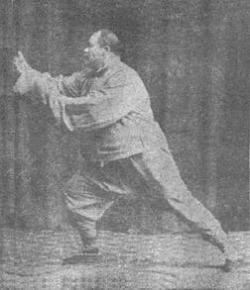
- Keep the head upright and relaxed. The head should be upright, not tilted, the neck straight but relaxed. No muscular force should be used, since stiffness blocks the flow of blood and «chi». The body stays straight, relaxed yet «alive» — in this way the spirit is lifted.
- Relax the chest and keep the back straight. The chest should be relaxed to let the «chi» sink to the «dan tian».* When the chest is held this way, the back straightens naturally — vital for rooting from the spine down to the soles of the feet.
- Relax the waist and lower back. The waist is the centre of the body and its ruler; only when you can relax it can the legs have strength and the lower body be stable. The change from full to empty comes from the movement of the waist, so if the form lacks power, the problem lies in the waist and legs.
- Separate empty and full. For many, the most important rule, based on the yin-yang principle: if the weight is on the right leg, it is «full» and the left is «empty». This is essential to turn nimbly and effortlessly; without it, the steps are not fluid and the postures become awkward and unstable.
- Sink the shoulders and relax the elbows. Shoulders and elbows should be relaxed — neither too close nor too far from the body, and without tension. If the elbows lift, the shoulders cannot relax, the «chi» does not circulate properly, and a push will lack power.
- Use «yi» (意, intention) instead of force. The body must be relaxed and free of tension so movements are light and fluid and the «chi» can circulate freely. Use the mind — the intention — rather than force to direct movement: where the intention goes, the «chi» follows. In Tai Chi it is said that «from the greatest softness comes the greatest strength».
- Harmonise the lower and upper body. Classical Tai Chi theory says: «The root of energy is in the feet, it rises through the legs, is directed by the waist, and expressed in the hands and fingers.» If you move the hands, you must also move the hips and legs; only then are the upper and lower body in harmony. If one part does not move, it is not coordinated with the rest and harmony is lost.
- Unite the internal and the external. In Tai Chi it is said that the spirit initiates the action and the body carries it out — mind and body must move together and in the same direction.
- The movement must be fluid, continuous and unbroken. Tai Chi movement must be continuous, circular and flowing, with no interruption from beginning to end — achieved by using intention («yi»), not force.
- Seek stillness within movement. In Tai Chi, even in motion, one keeps calm and a certain stillness, achieved through slow, continuous movement and long, deep breathing. This is why, unlike other martial arts where practice leaves you breathless, in Tai Chi the pulse never races.
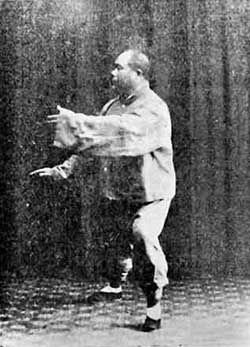
* The lower «dan tian» is a point about three fingers below the navel and inward — of great importance in Chinese medicine, Tai Chi Chuan and qigong (chi kung).
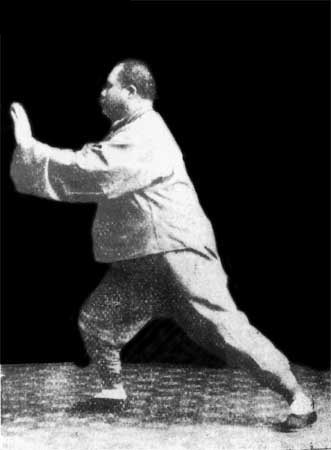
Principles by Yang Cheng Fu. Translated and adapted by Tin Sing Kwun (María Arias Antoranz 何天萍).


